
Ori: mixed-use development
Purpose: The Ori apartment building in Braddon ACT have applied multiple design elements from the Urban Design Guide. This resulted in high quality best-practice design outcomes for the ACT community.
Location: 30 Lonsdale Street, Braddon, ACT
The Ori apartment development creates a well-designed and inviting public space in Lonsdale Street. This space encourages social interaction by promoting accessibility, providing solar access, and including infrastructure for active travel connections. The materials and design of the building interfaces enhance the sensory experience and provide leisure opportunities. This adds to the overall comfort and enjoyment of communal areas.
Why is this important?
Detail and visual interest at ground floor level supports the positive sensory experience of buildings in the public space.
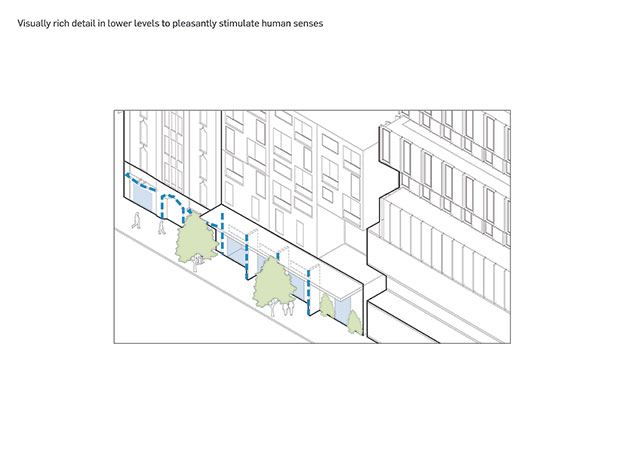
In a busy urban area like Braddon, creating diverse public spaces is important. These spaces should be adaptable, inclusive, and capable of meeting various needs. The Ori development achieves this multifunctional approach. This is done by including elements like:
- residential and commercial balconies
- outdoor seating, and
- indoor public seating.
This results in a lively and responsive public space, ensuring pedestrian comfort and convenience.
Ori’s design joins natural elements like trees and landscaping to enhance sustainability and community wellbeing. Flexible outdoor spaces foster a vibrant and appealing urban environment. This is done by including balconies and a range of different kinds of public outdoor spaces. This approach aligns with the ACT Government’s aim to mitigating climate change effects and enhancing urban liveability.
The Ori serves as an example of mixed-use design. They utilise materials and landscaping to encourage social interaction and community building. It connects with the urban environment, enhancing comfort and offering diverse outdoor spaces. This also contributes to sustainability and community wellbeing.
Roseneath St: multi-residential development
Purpose: 122 Roseneath St is a community of 49 apartments and 18 townhouses. It is in Clifton Hill in Melbourne on a former brownfield factory site.
Location: 122 Roseneath Street, Clifton Hill, Melbourne, VIC
The multi-residential development emphasises the creation of shared spaces. This includes a north-facing terrace, herb gardens, and communal spaces. This fosters a strong sense of community. This aligns with the design guide of an open space network that supports urban renewal and community building.
The design focusses around fostering a strong sense of community. The development consists of one, two and three-bedroom apartments and two and three-bedroom townhouses. It is designed around flexible, shared spaces. This includes:
- a multi-purpose communal room
- a north-facing terrace with a barbeque area and herb gardens,
- a workshop for messy jobs and
- a communal laundry.
The development shows how higher density forms of housing can be successfully integrated into a suburb consisting of mainly single dwelling homes. Such as townhouses, apartments and active ground floors. 122 Roseneath St provides housing choice and supply on a ‘missing middle’ scale. This is in an existing area with high levels of amenity and walkability. The development achieves a low rise/high density typology that preserves the existing street frontage rhythm. This is done by ensuring the new development is responsive to the existing character of the neighbourhood.
Why is this important?
Providing a choice of housing types and sizes adjacent to each other has a range of benefits. In particular, for the community in which it sits. It allows people of different living arrangements, ages, incomes and family structures to live close to each other. It enables flexibility to stay within the community if housing needs and circumstances change. It helps to prevent urban segregation. It promotes a sense of community when people meet outside of their regular network.
The multi-residential development at 122 Roseneath St offers a strong sense of community. It provides diverse housing options, responds to the existing neighbourhood character, and enhances urban living sustainably and with thoughtful design.
Kingsborough Development
Purpose: The Kingsborough development in Kingston ACT is an example of where multiple design elements from the Urban Design Guide have been applied. It results in high quality best-practice design outcomes for the ACT community.
Location: Kingston, ACT
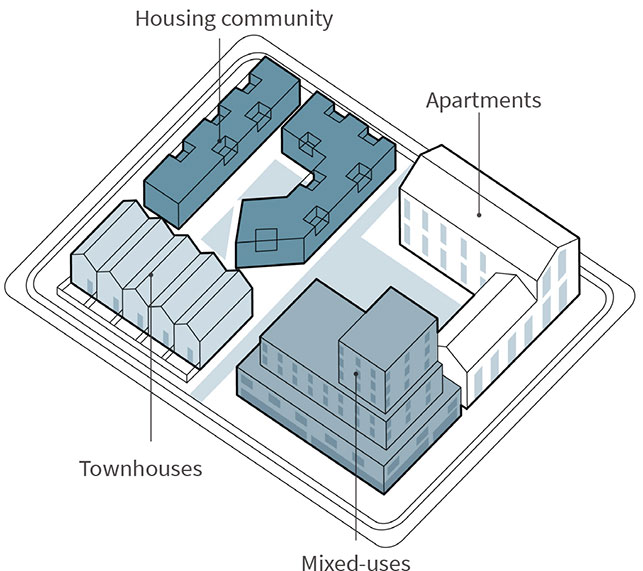
The Kingsborough development demonstrates a variety of lot sizes and building types within a standard Canberra plot grid. The development creates a range of experiences and open space typologies. This is done by using different architectural elements, materials, landscaping and street furniture. The project also establishes a clear hierarchy of activity centres. It fosters pedestrian and cycle-friendly movement networks to promote a lively community. Emphasis is placed on adaptability and sustainability to ensure long-term resilience.
The block configuration and structure promote a human-scale development, encouraging walking and cycling within the village. People are invited to interact with the buildings and utilise the spaces in between. This is done by diverse uses, materials, and activations at ground level. Prioritising a walkable urban environment lays the foundation for a healthy and dynamic neighbourhood. The development focusses on sustainability, accessibility, active travel, and thoughtful building interface design. It fosters a diverse and inclusive urban environment. This environment enhances year-round comfort, safety, and community engagement.
The diverse structure and layout of the buildings in the Kingsborough Village will be adaptive longer term. Resilience will increase in the urban area. This is done by creating the ability for buildings to adapt to changing needs, uses, densities and pressures on land value.
The Kingsborough development demonstrates how a precinct can be both cohesive and diverse at the same time. It also provides interest for residents and visitors alike. This is done through a design that is adaptable and flexible to changing needs.
Why is this important?
Open spaces will be used more and activated by incidental use and meetings. This is done by making open spaces easy to access for pedestrians and cyclists. They can locate them along active mobility movement corridors. This in turn will increase safety and amenity for the adjacent residents by having more activity and eyes on the street.
The Kingsborough development demonstrates integrates diverse lot sizes and building types while enhancing the quality of public spaces. This approach creates adaptable, walkable, and inclusive spaces, fostering a resilient urban environment for residents and visitors.
Taisugar Circular Village
Purpose: The Taisugar Circular Village in Taiwan is an example of where multiple design elements from the Urban Design Guide have been applied. It resulted in high quality best-practice design outcomes.
Location: Guiren District, Tainan City, Taiwan
Taisugar Circular Village is designed with circular economy principles at the forefront. This has been done with materials reused throughout the development and virtually no waste created. The design of the building considers assembly in construction and deconstruction after use. Selected materials and construction methods support reuse of materials after the end of the building’s life. For example, steel was chosen as the structural materials rather than reinforced concrete to support reuse of materials.
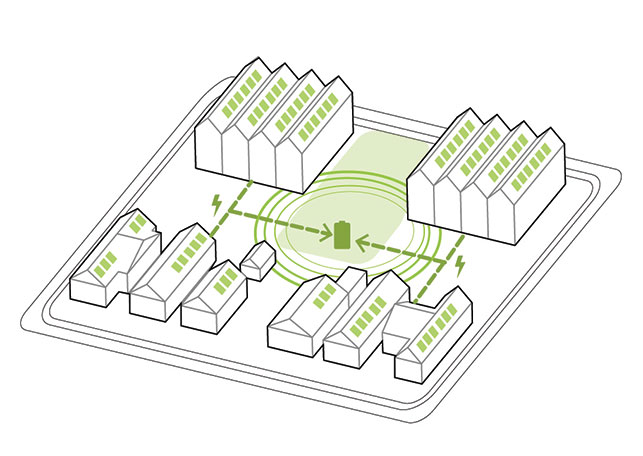
The Village is an exemplary development that places a strong emphasis on the efficient management of natural resources. It incorporates energy generation and water systems. This captures and stores renewable energy and manages water sustainably. This enhances its resilience and long-term sustainability. The integration of energy systems and a focus on sustainable food production within the community benefits the immediate residents and contributes to the wider transition to sustainable energy practices and resource management.
Why is this important?
Purposeful design of the built environment can support greater resilience in a changing climate and future-proof our cities. Reuse of materials can provide potential economic savings and reduce greenhouse gas emissions and our reliance on natural resources.
Taisugar Circular Village is an exemplar of effective governance and sustainable practices throughout every stage of its construction. It contributes to the mitigation of global warming and the promotion of sustainability within the built environment.
Contact us
A dedicated hotline is available to answer your questions about the new planning system.
Phone: 02 6205 0580
Email: NewPlanningSystem@act.gov.au

